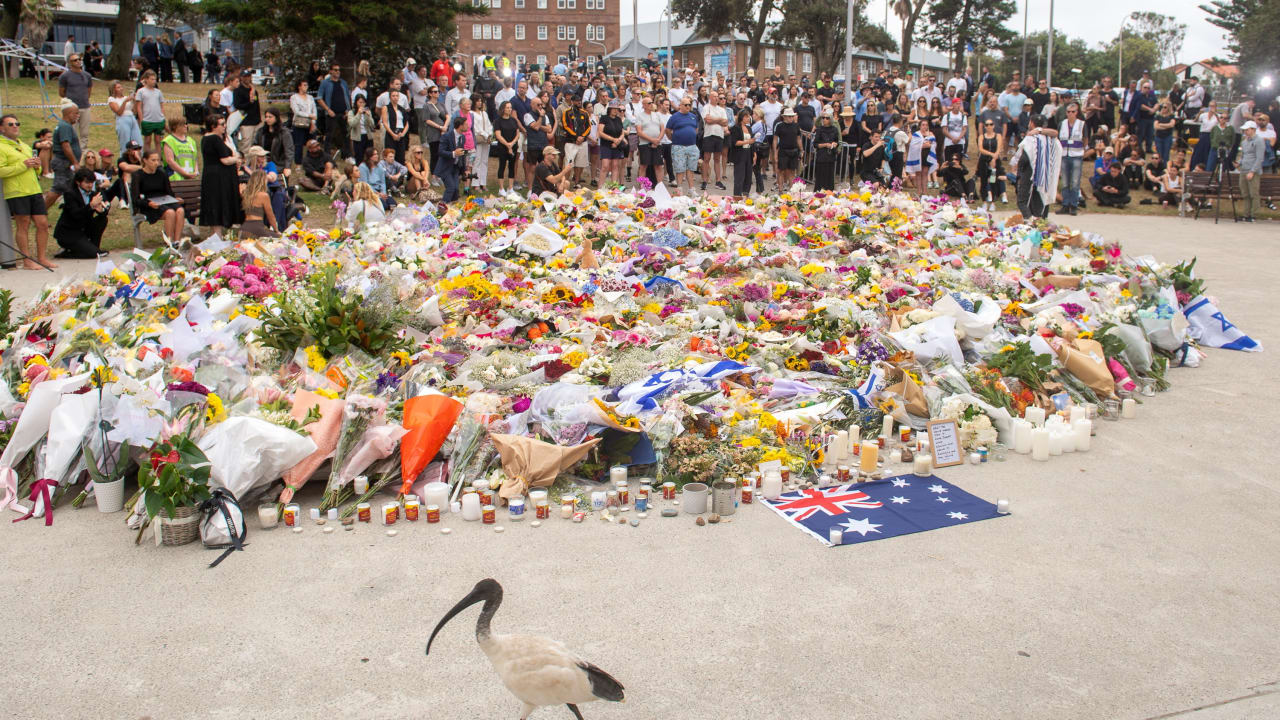
Hanukkah this year was darker yet more defiant. The terror attack at a candlelighting ceremony at Bondi Beach cast a long shadow but failed to extinguish the holiday spirit.
The eight-day festival, which started Sunday night, celebrates the victory of the Maccabees over the Syrian-Greek Seleucids in the second century BCE; the rededication of the Temple in Jerusalem; and how the one cruse of untainted oil lasted eight days to keep the menorah in the Temple alight.
It’s one of several Jewish holidays often summed up as: “They tried to kill us, we survived. Let’s eat.” (The food in this case being oily donuts, latkes, and sfenj.) Above all, it’s a reminder of the Jewish ties to Jerusalem, which our enemies wish to erase.
Shortly before the start of the holiday, a video was published of hostages Hersh Goldberg-Polin, Eden Yerushalmi, Carmel Gat, Alexander Lobanov, Almog Sarusi, and Ori Danino lighting a makeshift hanukkiah in a Hamas terror tunnel in Gaza two years ago, clearly providing light and comfort to each other and feeling a connection with their homes, families, and traditions.
It was impossible not to be moved by the sight, particularly knowing that the entire group – “The Beautiful Six” – was murdered by their terrorist captors when IDF forces came close. The video was filmed by Hamas, probably as part of its psychological warfare, and was discovered by the IDF as it routed the terrorists.

Before and after the October 7 Massacre
Everything in Israel is divided into “before” and “after” October 7, 2023. Even with a fragile ceasefire, all the live hostages back home, and all the bodies returned except for police officer Ran Gvili, the country has a way to go before recovering from the trauma of the Iranian-sponsored, Hamas-led invasion and mega-atrocity, and the two years of war and rocket and drone bombardments from multiple fronts.
The wave of antisemitism is also sadly familiar. It existed before October 7, but gained frightening traction immediately afterward, even before Israel began the ground operation to fight back. Particularly shocking was the speed, scope, and places with which vile antisemitic acts were perpetrated in countries like Canada and Australia, traditionally considered havens of laid-back coexistence.
This week in Sydney, the full horror exploded in a hail of terrorist bullets as two men – a father and son of Pakistani origin – shot at the throng of people who had come to celebrate the Chabad-sponsored annual “Hanukkah by the Sea,” at the city’s iconic Bondi Beach. The death toll as I write stands at 15 – the youngest a 10-year-old girl and the oldest an 87-year-old Holocaust survivor.
This wasn’t a spontaneous act. It was a well-planned terror attack, targeting the Jewish community as it celebrated a religious holiday.
The writing was literally on the wall, in hate-filled graffiti. There have been thousands of attacks since October 2023 on Australia’s Jewish community, including arson attacks on synagogues, schools, and kosher restaurants.
At a rally of tens of thousands of demonstrators in Sydney in August, organized by the Palestine Action Group, banners of al-Qaeda, ISIS, and the Taliban were seen among the Hamas and Palestinian flags.
On Sunday, the world got another reminder of what their slogan “Globalize the Intifada!” looks like. A blood-red line links the fatal shooting on Yom Kippur at a British synagogue in Manchester, the massacre of Jews celebrating Hanukkah at the beach in Sydney, and the attacks and attempted attacks on Christmas markets in Europe. Global jihad is not aimed at the Jews alone.
Writing in The Jewish Independent, my former colleague Sharon Berger declared: “No, I’m not okay.” The “avid ocean-swimmer” who regularly swims at Bondi had seen the warning signs. “Over a year ago at Bondi Beach, a man I didn’t know called me a baby killer for wearing a shirt with Hebrew on it,” she wrote.
“... Recently, there was some ugly anti-Israel graffiti down at Bondi Beach. The police were quick to cordon it off and organize repainting so that it would not interfere or upset local residents, including the Jewish community that lives in the eastern suburbs...
“Synagogues have been burnt down, as well as the kosher shop around the corner from where we live, so it’s not totally shocking that it would end this way, in the brutal murder of over a dozen innocent civilians. The rhetoric, protests, and graffiti seem to be allowed to escalate unchecked, but we all know there are consequences. Today made that blatantly clear.”
The scene reminded her of a particular image seared in her mind since the Second Intifada in Israel.
Sharon was one of the first people I thought of when news of the attack broke. Another was Arsen Ostrovsky, a human rights lawyer and regular contributor to The Jerusalem Post. He moved to Sydney with his wife and two sweet daughters just last month, to head the local office of the Australia/Israel & Jewish Affairs Council and play a role in tackling the rising antisemitism.
A photo of his clearly shocked, blood-covered face as he lay on the ground is hard to forget. And we shouldn’t forget. He had his own personal Hanukkah miracle amid the horror: a wound where a bullet scraped his head required stitches, but his life was saved by a matter of millimeters.
Interviewed shortly afterward on Channel 9, he described the absolute terror of not knowing initially what had happened to his family (they were physically not harmed) and described the scene as a “bloodbath” and “chaos,” reminiscent of the October 7, 2023, massacre by Hamas at the Supernova music festival.
“In dark times, there are those who curse the darkness and others who light a candle,” wrote Rabbi Jonathan Sacks, the late chief rabbi of Britain and the Commonwealth.
The light in the darkness was provided by Ahmed al-Ahmed, a Muslim Syrian immigrant, who heroically tackled one of the terrorists and was wounded in the struggle.
Australia's Labor government, led by Prime Minister Anthony Albanese with the help of Foreign Minister Penny Wong, has taken several steps against Israel since the start of the war, including declaring support for a Palestinian state without preconditions, sanctioning the Jewish state, and denying visas to an increasingly long list of Israelis, including lawmakers.
Albanese predictably rejected claims by Prime Minister Benjamin Netanyahu that his actions helped prepare the fertile ground for the Bondi massacre. But, as Moroccan journalist Amine Ayoub wrote in The Jerusalem Post this week, the Sydney attack “wasn’t a tragedy; it was a receipt. It was the bill coming due to years of Western complacency, bureaucratic cowardice, and a suicidal tolerance for the intolerant.”
During talks on the future of Gaza and Western relations with Iran, the parties would do well to keep in mind which regimes fund and ideologically foster terrorism, and where support for Iran, Turkey, Qatar, and the Palestinian Authority, among others, leads.
The “barbarians at the gate” breached Bondi Beach with ease. The terrorist attack wasn’t the result of loose gun laws, as the Australian government would like us to believe. Whether the perpetrators were affiliated to ISIS (whose flag was found in their car) or the Islamic Republic of Iran, suspected of being behind several of the previous attacks on Jewish targets in Australia, one thing is clear: they operated in an atmosphere of hatred.
The mass rallies, the media bias promoting the false Hamas narrative, the cyberbullying, and the attacks left without a response were contributing factors to the slaughter in Sydney.
Leaders around the world condemned the attack, as did the global media. Some acknowledged that Jews were the targets, others, at least initially, preferred to preserve the illusion that this was just some kind of natural tragedy at the beach rather than the result of a tsunami of antisemitism.
Some immediately called for the cancellation of public Hanukkah celebrations, determining that it was better for the Jews to hide than to add security and protect them. Others made a point of encouraging open celebration of the Jewish festival.
I’ll let Rabbi Sacks have the last word: “Judaism and its culture of hope survived, and the Hanukkah lights are the symbol of that survival, of Judaism’s refusal to jettison its values for the glamour and prestige of a secular culture, then or now. A candle of hope may seem a small thing, but on it the very survival of a civilization may depend.”