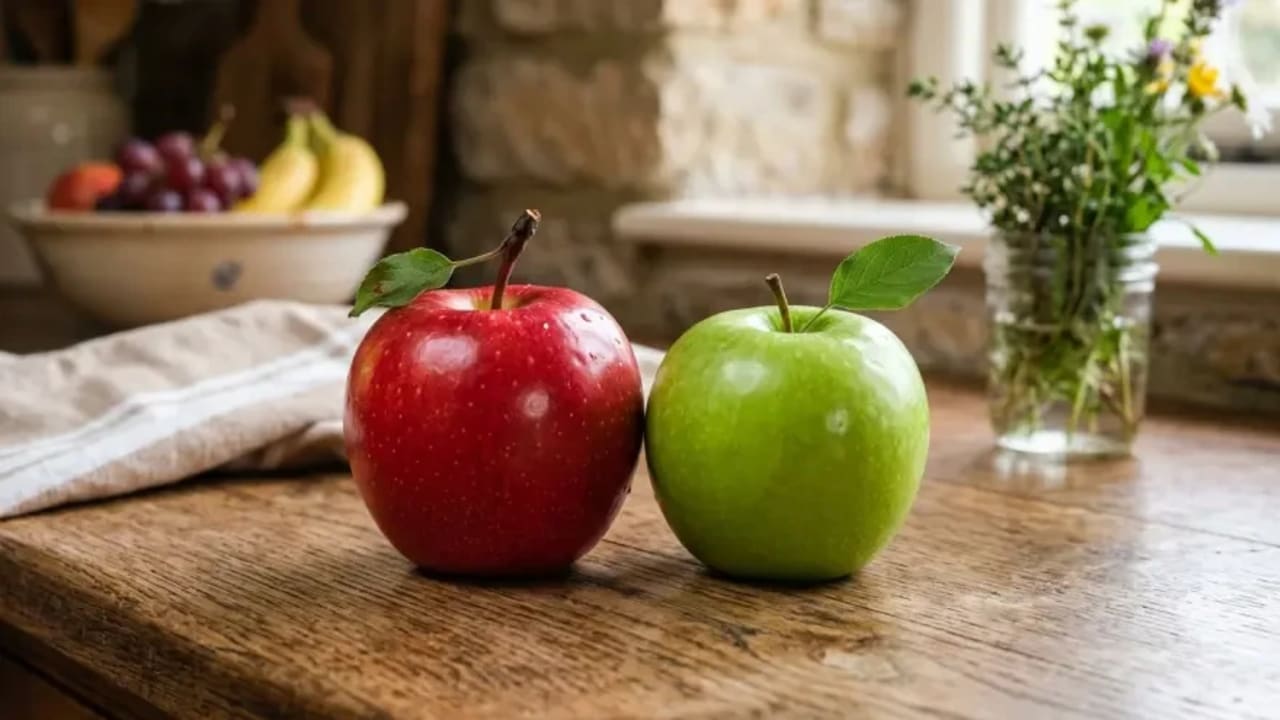
Green, red, yellow, sour, and sweet. The apple shelf offers many varieties, and therefore the question arises again and again: Which apple is better from a health standpoint? Does a sweet red apple have more sugar? Is a green apple more suitable for diabetes, and what is lost when peeling the skin? We will shatter all the myths and check whether an apple a day really keeps the doctor away... and first of all – there is no single color that always wins. Differences between apple varieties exist, but they depend on the exact variety, the degree of ripeness, and the growing conditions, not just on the question of whether the peel is red or green.
Sweetness does not tell how much sugar there is
The sensation of sweetness is influenced by the ratio between the sugar and the acids in the fruit. A green apple usually contains more malic acid, making its taste sourer, even when the amount of sugar in it is not very different from that in a red apple. Studies comparing many varieties found differences in sugar and acid content, but there is no simple rule according to which every red apple contains more sugar than every green apple. Sometimes a sour variety contains a significant amount of sugar, but the acidity masks part of the sweetness. Therefore, taste is not an accurate way to estimate the amount of sugar.
How much sugar is in an apple?
In most apple varieties, there are about 10 to 14 grams of sugar per 100 grams, but the amount varies among varieties and with the degree of ripeness. An edible apple weighing about 180 to 200 grams may contain about 18 to 25 grams of sugar. Quantitative speaking, it can be said that this is roughly the amount of sugar in four to five teaspoons, but nutritionally, an apple cannot be compared to eating teaspoons of white sugar. In the whole apple, the sugar is located inside the fruit tissue alongside water and fiber, and it requires chewing. This structure slows down eating and affects satiety and digestion speed differently. Observational studies have even found a connection between the consumption of apples and pears and a lower risk of type 2 diabetes. Of course, this does not mean that an apple prevents diabetes, but the findings do not support treating the natural sugar in an apple as if it were added sugar in candy.
Color alone does not determine what is healthier
Red apples contain anthocyanins, the pigments that give the skin its red color. In apples of all colors, additional polyphenols are found, including procyanidins, catechins, chlorogenic acid, and quercetin compounds. But – it is incorrect to sweepingly assume that green apples are richer in quercetin or better for balancing sugar. The polyphenol composition varies greatly between varieties, and sometimes the difference between two red varieties is larger than the average difference between red ones and green ones. Even a vivid color does not guarantee that the total antioxidant content is higher.
The practical choice is simple
Choose the apple that tastes good to you! Varying between varieties and colors is a good idea, but there is no need to look for a single variety considered the "healthiest." Another question you sent me – Are ancient apple varieties considered better? In some studies, higher concentrations of polyphenols were found in certain traditional varieties compared to common commercial varieties. It is possible that breeding apples for a sweeter taste, uniform appearance, and storage resistance also altered part of their composition. But here, too, there is no absolute rule. Studies have found new varieties that contained a similar or even higher amount of active compounds compared to older varieties. Therefore, it cannot be determined that every small, local, or sour apple is healthier than a modern, sweet apple. Specific varieties must be compared rather than relying on the story behind them.
With or without the peel?
A higher concentration of polyphenols is found in the peel compared to the inside of the apple, especially quercetin compounds and anthocyanins in red varieties. Therefore, eating an apple with its peel allows you to get more of these components. Despite this, it is very important for me to say – a peeled apple does not become a worthless fruit. In a study comparing peeled and unpeeled apples, it was found that the overall differences in fiber, vitamin C, magnesium, and tested polyphenols were smaller than commonly thought. Peeling also reduced pesticide residues, although even in unpeeled apples, the measured exposure level was much lower than acceptable limits. The conclusion is that there is no need for guilt. Those who like the peel can wash it thoroughly and eat it. Young children, people with chewing difficulties, or those who simply do not like the texture can peel it and still enjoy a nutritious fruit.
A whole apple is more filling than juice
The form in which the apple is eaten affects no less than the color. In a study comparing a whole apple, purée, and juice, the whole apple created a greater sense of satiety and led to the consumption of fewer calories in the meal that followed. In another study, it was found that a whole apple emptied from the stomach more slowly than purée or juice, contributing to a longer-lasting feeling of fullness. Therefore, apple juice is not nutritionally equivalent to an apple. In juice, it is easy to consume the sugar of several apples within minutes, without the same amount of fiber, chewing, and satiety. Even adding a little fiber to juice did not replicate the effect of the whole fruit in the study.
How many calories are in an apple?
The number of calories depends mainly on the size, not the color. In 100 grams of apple, there are about 50 to 55 calories. A medium apple usually provides about 80 to 100 calories, and a very large apple may reach 120 calories or more. An apple can serve as a convenient snack, but the degree of satiety is personal. For those for whom an apple alone does not keep them full for long, a few nuts, yogurt, or another protein source can be added.
Do apples really affect health?
Reviews of randomized studies found at most moderate effects on some cholesterol measures, and no clear change in all measures of sugar, blood pressure, or weight. Observational studies found more positive connections, but they cannot prove that the apple itself caused them. In other words, an apple is a good fruit, not a medicine. Its benefits stem from the combination of water, fiber, polyphenols, and ease of eating, and mainly from the fact that it can replace a more processed, sweeter snack.
The bottom line
A green apple is not necessarily lower in sugar, and a red apple is not necessarily richer in antioxidants. The acidity, variety, degree of ripeness, and size of the fruit are more important than color alone. You can eat an apple with the peel or without it, but it is preferable to choose the whole fruit rather than juice. Ultimately, the healthiest apple is the one that tastes good to you and that you will actually eat, not the one left in the bowl because you chose it based solely on color.
For Dr. Maya Rosman's YouTube channel: With all the tip videos – Click here