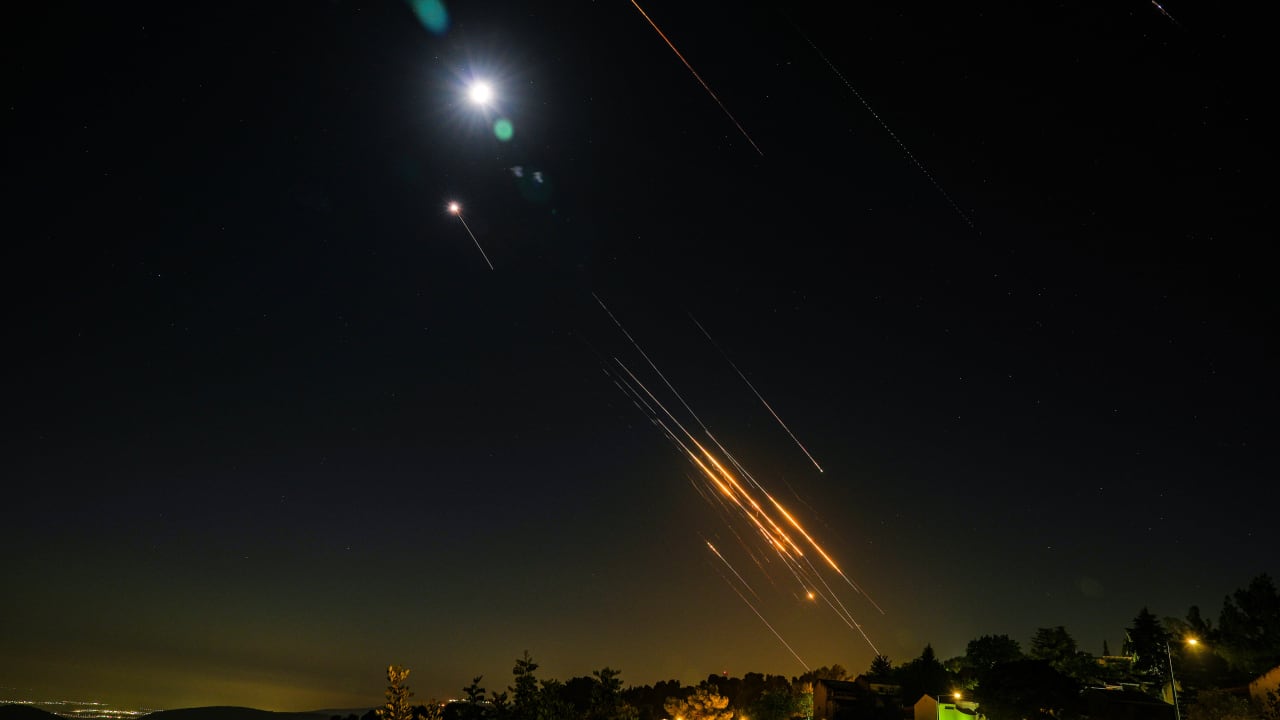
Although June 13, 2025, will go down in the history as the date that changed the Middle East forever, likely even more than October 7, 2023, the truth is that the real dates that had already shifted the course of history were April 13 to 14, 2024.
On that day, concluding a decades-long covert shadow war with Israel, Iran transformed the region by openly and directly attacking the Jewish state with more than 100 ballistic missiles, 170 drones, and dozens of cruise missiles.
Israel struck back on April 19, 2024, by attacking one S-300 anti-aircraft defense system that was guarding the Islamic Republic’s nuclear facility at Isfahan.
Prime Minister Benjamin Netanyahu and the cabinet (which then included defense minister Yoav Gallant and war cabinet minister Benny Gantz) never seriously contemplated bombing Iran’s nuclear sites that April like it considered doing so in October later that year, or like it finally did eight months later on June 13; but it was that first direct exchange between the sides which set the stage for the current regional war.
The Jerusalem Post, with access to a wide range of top political and defense decision-makers, previously revealed the full extent of the debates among Netanyahu, Gallant, then-IDF chief Lt.-Gen. Herzi Halevi, Gantz, war cabinet minister Gadi Eisenkot, and then-Mossad director David Barnea, culminating in decisions to limit attacks on Israel’s arch enemy and to avoid striking its nuclear program – until early May of this year.
Now the Post connects those evolving events to the story of the final shift that led to Israel’s historic decision, largely Netanyahu’s, to strike Iran’s nuclear program – at the minimum, the Natanz and Isfahan nuclear facilities – and to engage in an open all-out war with Tehran, including killing Iran’s three top security chiefs in the opening hours of the campaign.

Changing realities, changing personalities
Netanyahu’s final decision was less about a sudden point of no return and more about a deep personal evolution and changing national circumstances over time.
For example, the debates about how much to attack Iran had already evolved in October 2024 after the Islamic Republic attacked Israel directly a second time on October 1, 2024, this time with more than 200 ballistic missiles.
An overlapping cast of characters debated the issues, but Gantz and Eisenkot were already off the reservation, having quit the government on June 9.
There was even a third round of the least reported debates after October 26, but they were prior to Donald Trump’s entering office and replacing Joe Biden as US president.
By that time, Gallant was also mostly out of the loop, given that Netanyahu nixed him as defense minister on November 5, leaving Netanyahu along with defense chiefs Halevi, Barnea, and some of their top advisers.
Defense Minister Israel Katz also entered the picture, replacing Gallant.
But given his lack of top military experience and that he is a Netanyahu lieutenant within the Likud Party, he has not held the same potential push-back power on critical decisions as some others.
What was radically new in the debates after October 26, 2024, was that Israel now had ascertained that it could destroy Iran’s nuclear facilities nearly at will.
In contrast, up to that point, Jerusalem had worried about the Israel Air Force’s capabilities going head to head with Iran’s S-300 anti-aircraft defense systems for a long enough stretch to strike a sufficient number of Iranian nuclear targets to bring the program down.
Despite the new assurances, Netanyahu decided on restraint.

Back to April 2024
Rewinding, roughly speaking in April 2024, Eisenkot and Gantz had worried the most about limiting the Jewish state’s counter strike to avoid a downward spiral of escalation leading to a regional calamity.
The prime minister also did not want to overdo it, yet he appeared more prepared to roll the dice. This shift of Netanyahu gradually being more confident about using fateful amounts of military force is one of the major stories of the war – and is also critical to understanding the decision to go full-out against Iran last week on June 13.
Barnea, who is often the point man on Iran issues in the defense establishment, favored a real counter strike, but he did not want to commit to an exact course of action without deeply coordinated US support for whatever Israel did to hit back and for its broader war goals.
Gallant and Halevi sounded the most aggressive regarding a counter strike.
Eventually, Netanyahu joined his two defense and military chiefs regarding the concept of attacking Iran’s S-300 anti-aircraft missile system that was defending its Isfahan nuclear facility. Even later, Gantz and Eisenkot – both former IDF chiefs – were split on this: Gantz supported such a strike, while Eisenkot continued to oppose it.
By the time Iran attacked Israel a second time on October 1, 2024, the position of top officials had shifted again.
While Gallant and Halevi still wanted to strike Iran hard in relative terms, they had moved toward being even more closely aligned with the US and ready to avoid attacking Iran’s nuclear program in order to maintain Biden administration support.
HOWEVER, THE largest shift had taken place with Netanyahu. He was evolving from being one of the most hesitant about using force in October 2023 into being the leading hawk on all fronts.
Moreover, he was more ready than ever to defy the Biden administration, given that US Election Day was only a month off and Trump was favored in the polls.
At the time, his readiness to defy American demands was limited to Biden.
However, that mental shift – of being ready to defy Washington not only on smaller tactical issues but also on historic decisive strategic issues – would eventually make him more ready to defy Trump’s request last week to hold off on attacking Iran. (The president subsequently said he was in favor of the whole thing, and there was close communications between the two leaders on the possibility of an attack, but Trump still would have preferred more negotiations.)
Still, in October, Netanyahu believed it was critical for the US and its allies to help Israel protect itself from any potential additional rounds of Iranian ballistic missiles attacks.
He was not sure that Biden would have the US help with Israel’s defense if Jerusalem launched a larger attack on Iranian nuclear sites, which would itself likely lead to a larger war between the two mortal enemies.
This would change radically by June 2025, given that the Assad regime fell in December 2024, and by June Israel had spent months having achieved complete air supremacy over Syria – something unimaginable in October.

June to October 2024
By June, the picture regarding needing US help on defense had also changed.
Netanyahu still preferred American defense aid against Iran’s ballistic missiles and drones.
But he had also seen Israel’s own air defense take down large portions of Iran’s ballistic missile and drone strikes – not once, but twice – and felt more confident in Israel’s defensive capabilities to go it more alone against Tehran’s missile arsenal.
Barnea continued to support a middle-of-the-road aggressive approach against Iran, but he was still focused on requiring US support as a restraining factor.
Combining all of those approaches led to Israel’s decision to attack the four remaining S-300 missile defense systems in Tehran four months later in October, as well as a dozen other air defense and ballistic missile production targets. They also struck one nuclear-related target at Parchin on October 26.
At the time, Israel said that the significance of its attack was to reduce Iran’s ballistic missile production capacity from developing 14 new missiles per week to one per week with a one- to two-year recovery time.
Subsequently, upon starting the current war with Iran, Jerusalem has claimed that Tehran had near-future plans to build facilities that could produce tens of thousands of ballistic missiles – far overshadowing whatever might have been achieved in the October 2024 setback for the Islamic Republic.
These polar opposite Israeli claims in a period of six months could give a person whiplash and says a lot about how dynamic Netanyahu and other decision-makers’ approach to these issues became at different points in the war.
Maybe the most crucial outcome of Israel’s October 26 strike on Iran was that its hammering of Iran’s radar, tracking, and air defense capabilities effectively left the Islamic Republic’s nuclear program utterly exposed to a future decisive air force strike.
So why, then, didn’t Netanyahu immediately order such a decisive strike on Iran’s nuclear program on October 27, or at least in the limbo transition period between October 26 and Trump’s inauguration on January 20, 2025?

Iran’s proxies get in the way
A big part of the answer at the time lay with Hezbollah and Hamas.
Yes, Jerusalem had removed Iran’s best chance of competing in a heavy exchange of fire between the countries, but Israel was still under heavy fire on October 27 and even past US Election Day.
Around one-third of Israel, mostly in the North, was being attacked by Hezbollah rockets hundreds of times per day. Some rockets were even getting through to central Israel.
That was far fewer than Iran is now getting through and with far less deadly consequences, but the ongoing Hezbollah threat was not something to discount out of hand.
This was true even though Israel was overwhelmingly “winning” the exchange because it would not be a win if it indefinitely sustained heavy Hezbollah rocket attacks.
Hamas in the South no longer had such capabilities, but it still presented a threat, which meant that many southern residents were hesitant about returning to their homes.
Unlike now, when Hamas’s hostage number is down to 53, of which only 20 to 23 are alive, the brutal terrorist group still held around 100 hostages, half of whom were still alive – or more than double than who are thought to be alive now.
Israel was also being confronted by almost daily ballistic missiles from Yemen’s Houthis, which sent millions of Israelis in the Tel Aviv and central Israel corridors into their bomb shelters every time they were fired. The government believed all of that could end without heavy casualties if it reached deals with Hezbollah and Hamas, without getting into a bigger fight with Iran.
Jerusalem worried, correctly, that a potentially broad military campaign with the distant Islamic Republic could involve multiple rounds of exchanges of many hundreds of ballistic missiles more than before.
So top Israeli officials wanted to wipe the playing field clean of the other threats.
Israel only reached a ceasefire with Hezbollah after November 27, 2024, and it was not really stable until February or even March of this year, as the Jewish state and the Lebanese-based terrorist group jockeyed over how the terms of the ceasefire would play out on the battlefield.
Eventually, Israel gained a major upper hand over Hezbollah even beyond what it had gained by November 27, but none of this was a guaranteed outcome in late 2024.

Hostage dealing, Trump’s wheeling
The hostage deal with Hamas did not take place until January 19, 2025, the day before Trump took office.
Netanyahu needed both Biden’s and Trump’s support to close the deal, which probably would not have occurred had the Jewish state rushed into open war with Iran.
The Hamas deal successfully took off pressure from the Houthis; and before Israel went back to war with Hamas on March 18 to 19, the US was striking the Yemen-based terrorist group much more aggressively to keep them busy on the defensive.
In fact – and no one will admit to this openly – had Trump kept striking the Houthis and not sealed a “separate peace” with them that left Israel hanging and alone on May 6, Jerusalem might never have started this war at all, or might have considered delaying its attack for longer.
Also, Netanyahu and top IDF and Mossad officials were – mistakenly – almost sure that Trump would be open to a full attack on Iran’s nuclear sites at some point in the middle of 2025. This meant that in late 2024, there was no rush.
Taking into account a number of changes from October 2024 to now, the largest factor that changed for Israel and Netanyahu was the removal of moderating voices like Gallant and Gantz (who were aggressive in late 2023 but became more moderate by mid-2024), as well as a feeling that Trump had betrayed Israel several times as 2025 drew on.
The American president turned from calling on Israel to strike Iran’s nuclear program in October 2024, to waving off its attack plans in private and then in public in 2025.
Trump started serious negotiations with Iran in mid-April, which included statements by his envoy Steve Witkoff that sounded like he would settle for a JCPOA 2.0 – a nuclear deal similar to Barack Obama’s 2015 nuclear agreement.
BY APRIL of this year, Israeli officials told the Post that they were in dread of what Trump might agree to, and their trust in him was deeply shaken.
Mossad Director David Barnea and IDF Intelligence Chief Maj. Gen. Shlomi Binder, along with Strategic Affairs Minister Ron Dermer and others, did all they could to convince Trump’s team to harden their negotiating positions, with some success.
But when they saw that Iran was digging its heels to maintain low-level uranium enrichment and refusing to destroy its advanced centrifuge fleet, conceding only that it would put them on ice, these intelligence and diplomatic officials feared the worst could come if a new and bad nuclear deal would be agreed to at any moment.
Had senior Israeli political and defense officials dreamed that such a bad deal was just as likely as Trump green-lighting an Israeli attack or his coercing Iran into a much tighter nuclear deal, some would have likely endorsed launching a major strike during the Biden-Trump transition.
Others, even looking back, would argue that the strategic importance of achieving ceasefires with Hezbollah, Hamas, and the Houthis was worth the price of delaying the strike on Iran until June.
Also, though no Israeli officials would say this publicly, even a mediocre nuclear deal could have given Israel time by reducing the nuclear threat Iran presented in June of being able to potentially produce enough enriched uranium in short order for 10 to 15 bombs.
What is apparent is that Israel’s public relations narrative, which specifically in June was that the moment of no return had almost arrived, is at least partially spin.
The real deadline for Israel to act was likely October 2025, when the global sanctions snapback mechanism was due to expire.
If Israel had let that expire without acting, its options and mix of pressures it could impose on Iran would have been greatly reduced.
There was also concern in Israel that after the October 2024 air force strikes, Iran was accelerating its building and moving of underground facilities, such as a new one at Natanz, one much deeper than the underground facility that Israel may have hit in the past.
Growing impatience, getting backstabbed
In the end, the timing of Israel’s strike on Iran’s nuclear program on June 13, after taking a pass in April 2024 and from October 2024 until June 2025, was more the product of Netanyahu and circumstances on many other fronts evolving than any single date of Iran’s reaching a point of no return.
Yes, the Islamic regime had accelerated the activities of its weapons groups so that maybe the time it would take to make a nuclear weapon – or many of them – was reduced from two years to one year or even several months.
But seeing the degree to which Israel had penetrated Iran’s nuclear and military programs, it is clear that Jerusalem had a clear line of vision on how far Iran had progressed – and sources had conveyed to the Post not long ago that Tehran was still not that close to the point of no return.
Iran had attacked Israel twice, and Jerusalem had shown restraint both times and was losing patience with that dynamic.
Israel had taken Hezbollah and Hamas mostly off the board, reducing its need for US cooperation and clearing its air force’s line of sight to focus on Iran, with fewer distractions.
The Islamic regime’s anti-aircraft defenses and efforts to move its sensitive program deeper underground were still at a weak point; but given more time, it would eventually become harder to strike them.
The Houthis were continuing their unending missile fire on Israel. Rather than the terrorist group and Iran understanding Israel’s threats at both of them to make progress at getting the Houthis to stand down, that front seemed to be getting worse because Trump had backstabbed Israel on the issue.
Trump had also shocked Israel, cutting a deal with new Syrian regime leader Ahmed al-Sharaa against Israel’s wishes and with almost no warnings, leaving Netanyahu and Israeli intelligence more doubtful about how he might surprise them regarding Iran.
And Trump continued to flirt with Iranian diplomacy, letting two of his own deadlines pass, proceeding on a path that only seemed to make sense if he was going to eventually be willing to make concessions that Israel did not want him to make.
Stalled nuke deal, time to act – alone
Then in June, Iran-US negotiations hit an extended, if temporary, wall.
The IAEA proclaimed that Iran was ramping up its nuclear program and could potentially produce enough uranium for up to 10 to 15 nuclear weapons; and the nuclear agency made its worst condemnation of the Islamic Republic since 2005, appearing ready to bring the issue to the UN Security Council.
Netanyahu and the air force felt more confident than ever about defending Israel from Iran’s expected counter strike mostly on their own, should Trump refuse to help Israel on defense (in the end the US has helped, though in smaller ways than in 2024).
At this point, rather than heed Trump’s request to hold off on attacking for some months, Netanyahu reached his own point of no return, where he believed he could roll the dice and change the course of the region one last time, even more dramatically than he did against Hezbollah.
It did not hurt that this would help convince Knesset Foreign Affairs and Defense Committee Chairman Yuli Edelstein to go along with the prime minister’s compromise to save his government from falling over the issue of haredi (ultra-Orthodox) integration into the military, though that was probably just a plus and not a primary consideration.
Sometimes history changes in an instant, with little warning, such as on October 7, 2023.
In contrast, the June 13 history-changing war against Iran was at least 14 months of ups and downs in the making.