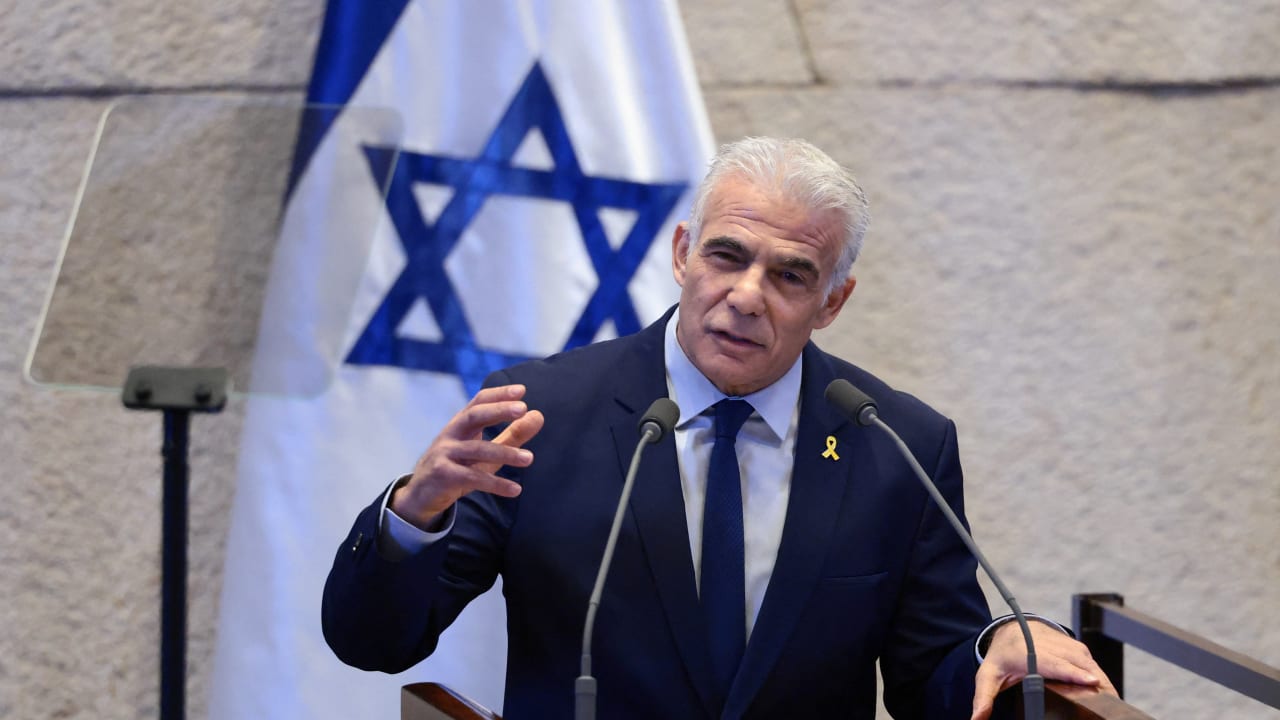
Opposition leader Yair Lapid rejected on Wednesday any option of a unified list ahead of the elections between his Yesh Atid party and the left-wing The Democrats party, led by Yair Golan.
Lapid said that the difference between him and Golan is comparable to the difference between him and Prime Minister Benjamin Netanyahu, in remarks during an Army Radio interview.
“They are left-wing; I am center,” he said.
After the interview, Lapid released a further statement explaining his stance about why he refused to merge with The Democrats.
“Here is the explanation: The Center is not halfway between the Left and the Right; it is an entirely different way of seeing the world.”

Israel has 'right to use force'
“We are national, liberal, patriotic; we believe in the Jewish identity of the state and in Israel’s right to use force,” Lapid added about his party.
“Yair Golan is no different from the distance between me and Likud (I was not referring, of course, to Netanyahu, but to the Likud of the past, which was national-liberal),” he clarified about his comments during the interview.
“Anyone who wants the full explanation of what the Center is is welcome to come to Yesh Atid conferences. There, they will meet many people who understand why only a strong Yesh Atid is the key to victory,” Lapid stated.
The Democrats is made up of the Labor and Meretz parties, which merged in 2024. In recent weeks, there have been reports of tensions within the two factions in the party.
Lapid said that only his Yesh Atid would be successful in forming a government without Netanyahu or the haredi (ultra-Orthodox) parties after the elections during a Monday press conference.
Elections are scheduled to take place no later than October.
He warned that recent polls and in-depth studies showed it was not certain that the parties rivaling Netanyahu in the “liberal camp” would win the elections and called for unity.
“Precisely because the camp is so fragmented, Yesh Atid is the key to victory,” Lapid said.
Among the party leaders in the opposition bloc are Golan, former prime minister Naftali Bennett, former IDF chief of staff Gadi Eisenkot (Yashar!), MK Benny Gantz (Blue and White), and MK Avigdor Liberman (Yisrael Beytenu).
Forming joint electoral lists among separate parties is a well-established practice in Israeli politics. In the most recent elections, several such alliances entered the Knesset, including Hadash-Ta’al and United Torah Judaism, which, ever since 1992, has united Agudat Yisrael and Degel Hatorah.
There have been talks of mergers between parties. Eisenkot proposed last month to create a unified list with Bennett and Lapid.
Lapid spoke against public voting for Bennett during the Wednesday Army Radio interview.
“When you go to vote, ask yourselves who you are certain will not go with Netanyahu, who has a real party, and whose list includes people you truly know and understand what they stand for,” he said.
The remarks come amid recent speculation about Bennett’s willingness to form a government with Netanyahu after the elections.
Bennett said on Tuesday that Israel needed “new leadership” following the October 7, 2023, Hamas attacks, suggesting he would not be willing to form a government with Netanyahu, though not directly stating such.
Lapid and Bennett formed a national unity government in June 2021. Within the coalition agreement, Bennett served as prime minister from June 2021 until July 2022. Lapid succeeded him until the government was dissolved in December 2022.